What Makes a Great Golf Course, Great?
Every golfer has a version of the same story at some point in their playing days. They visit a course. The fairways are green. The views are stunning. The clubhouse is polished. They walk off the 18th and declare it the best course they've ever played.
But was it? Or was it simply the best-conditioned course they've ever played, set against the nicest backdrop they've ever seen?
This distinction matters more than most golfers realize. The difference between a great golf course and a merely pleasant one has almost nothing to do with how green the grass is or how dramatic the scenery looks from the tee box. It has everything to do with what the architect did with the land — how the holes were routed, how decisions are presented to the player, and whether the design rewards thought and creativity. Appreciating that architecture and distinguishing it from the noise of rankings, reputation, and false dichotomy of pristine conditioning takes a little bit of study and willingness to think about the details.

Stanley Thompson’s Jasper Park Lodge - one of the world’s greatest golf courses, traverses the terrain gracefully, especially its bunkers which mimmic the peaks in the distance.
The Problem With How We Evaluate Golf Courses
Most golfers evaluate courses based on three factors. The conditions were excellent — grass was green and perfect, bunkers were raked. The price was fair. The beverage cart came around multiple times. Five stars.
There's nothing wrong with enjoying those things. But they tell you almost nothing about the quality of the golf course itself. When golfers play a course that's dramatically better-conditioned than what they're used to, with mountain views or ocean backdrops, they understandably assume they've just experienced greatness. The conditions become a proxy for quality. Rankings often compound the problem. The feedback loop says that courses are ranked highly, and they're then perceived as exceptional by the general public because they're ranked highly. Resulting in a confirmation bias.
People like rankings. But what rankings often fail to do it teach them what to look for to make your own informed decisions. If nobody explains the difference between a course that happens to occupy beautiful land and a course that was designed to make that land sing, the distinction stays invisible. It becomes “vibes over architecture”, rewarding the wrong design considerations and those who simply paint the place green and have effective marketing.
The Architectural Principles That Separate Great From Good
The best golf courses in Canada — regardless of when they were built or who designed them or if they are public or private — share a set of common architectural principles. These aren't arbitrary preferences. They're the foundational elements that create interesting, replayable golf.
Routing
Routing is the single most important element of golf course design. It's the sequence and placement of holes across the property — and it determines everything that follows. A brilliant green complex or a perfectly shaped bunker cannot save a course with a poor routing, but a great routing can elevate a group of modest individual holes into a more compelling story.
The best routings share several qualities. They use the natural terrain rather than fighting it. They change direction frequently. They vary the length, shape, and character of holes so that no two feel alike. And they put emphasis on building strategic considerations players must navigate.
At Highlands Links, Stanley Thompson routed his course from the headlands of Middle Head Island through dense forest in Cape Breton National Park, down into the Clyburn River valley, and back again. The journey is the architecture exclamation point. The course largely sits on top of the tumultuous landforms, creating this symphony of characteristics that remarkably capture the spirit of the game.
At Toronto Golf Club, Harry Colt's routing extracts maximum variety from a property that, on paper, might not seem extraordinary. The course moves through rolling, wooded terrain alongside the Etobicoke River, using a variety of elevation changes, creek crossings, and natural ridgelines to create holes that constantly shift in feel.
Compare that to courses where every hole runs parallel to the one beside it, plays in the same direction, and uses the same green complex over and over. These routings feel forced for the sake of golf. They exist because they were efficient to build, not because they were interesting to play.
Another example of why routing is important so important can be easily seen at the famed Banff Springs. I wrote about how routing impacts the rhythm of this golf course for Vol 1. of Golf Club Atlas’s Gazetteer magazine.
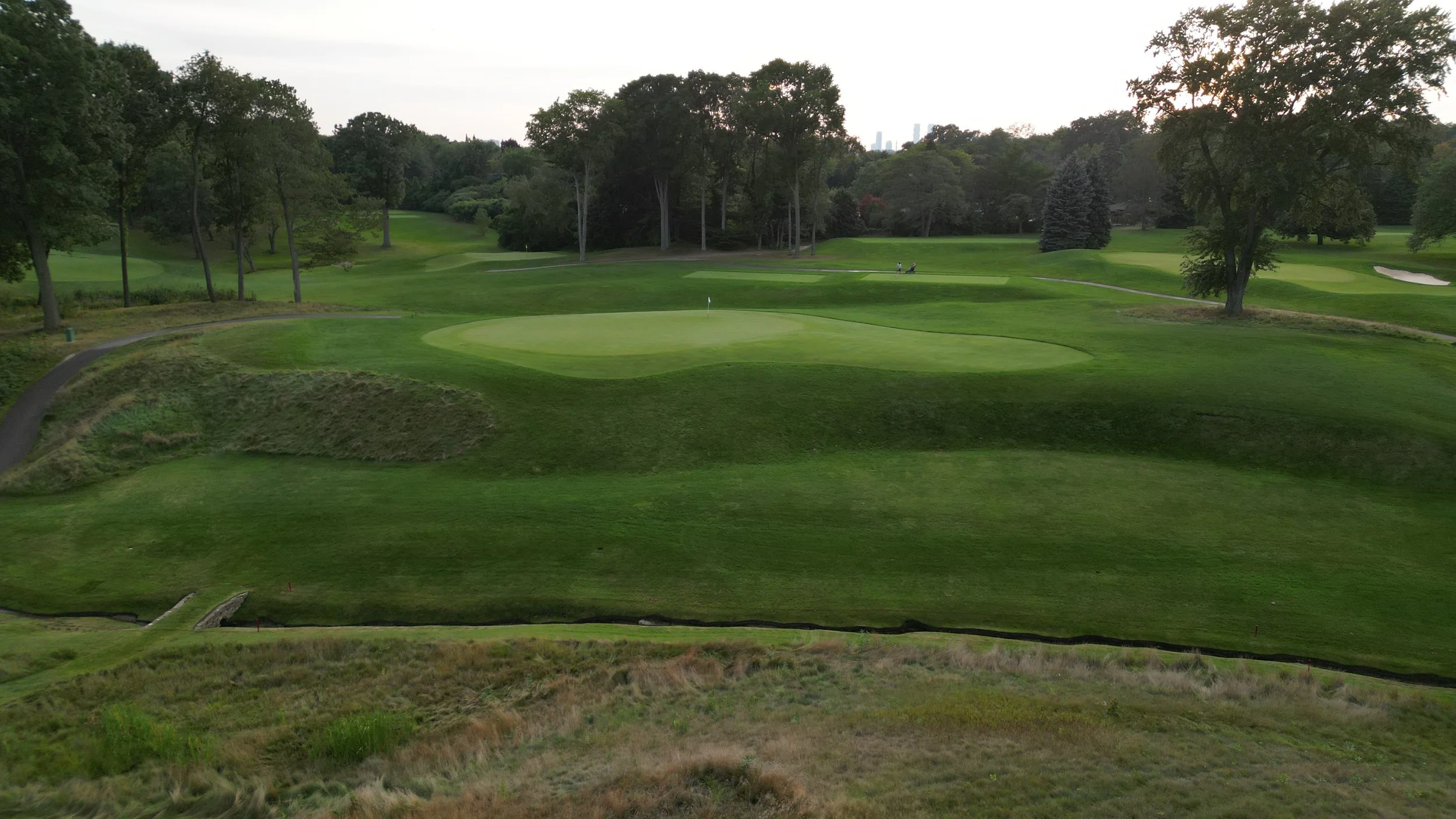
Toronto Golf Club’s fourth hole plays over the valley - one of the greatest par 3’s in Canada.
Strategic Width and Options
The second principle is strategic width — the idea that a golf hole should present the player with meaningful choices rather than a single correct answer.
On a strategically designed hole, the fairway is wide enough for every skill level to find it, but the position within that fairway matters enormously. A bunker or hazard on one side might block the ideal approach angle to the green, rewarding the player who challenged the hazard from the tee. A safe play to the wide side of the fairway leaves a harder second shot. The golfer is constantly weighing risk against reward, and different skill levels face different versions of the same puzzle.
This is the opposite of what's sometimes called penal design, where a narrow fairway is flanked by deep rough or water and the only question is whether you hit it straight. Penal holes test execution. Strategic holes test decision-making. The best courses lean heavily toward the latter.
At Cabot Links, Rod Whitman built wide, tumbling fairways on firm fescue turf that encourage a ground game — bump-and-run approaches, creative use of slopes, and low running shots that work with the terrain. The firm conditions mean the ball interacts with the ground in ways it simply cannot on soft, overwatered courses. A player who understands how to use the contours, or take on the various hazards has options that players who can’t does not. Width and firmness together create a decision-rich environment. This is strategy embedded in aesthetics.

A look at the eighth, ninth, and 14th greens at Cabot Links
Green Complexes
A great green complex is not just a putting surface, it's the entire package. The green itself, the bunkers guarding it, the slopes feeding into it, and the surrounds that allow for creative recovery shots. When all of these elements work together, every approach shot becomes more decisive.
We've written at length about what makes a great set of greens elsewhere on this site. But the key point here is that variety is essential. If every green on a course is the same size, the same shape, and defended the same way, the player faces the same question 18 times. The best courses present a variety between every hole.
At St. George's, Thompson's golf course is routed through glacial valleys, and the surrounding terrain does much of the defensive work. This allowed for a more creative vision for the greens. The third hole is a perfect example: from the tee, a half-dozen bunkers appear to be guarding the green aggressively, but the two front bunkers are actually well short of the putting surface. Beyond them, a hidden fairway of 40 yards feeds the ball onto the green. The player who understands the deception can easily run the ball into this long par 3, playing through the visual intimidation. The player who doesn't is left wondering why their cautious layup left them further from the hole than expected.
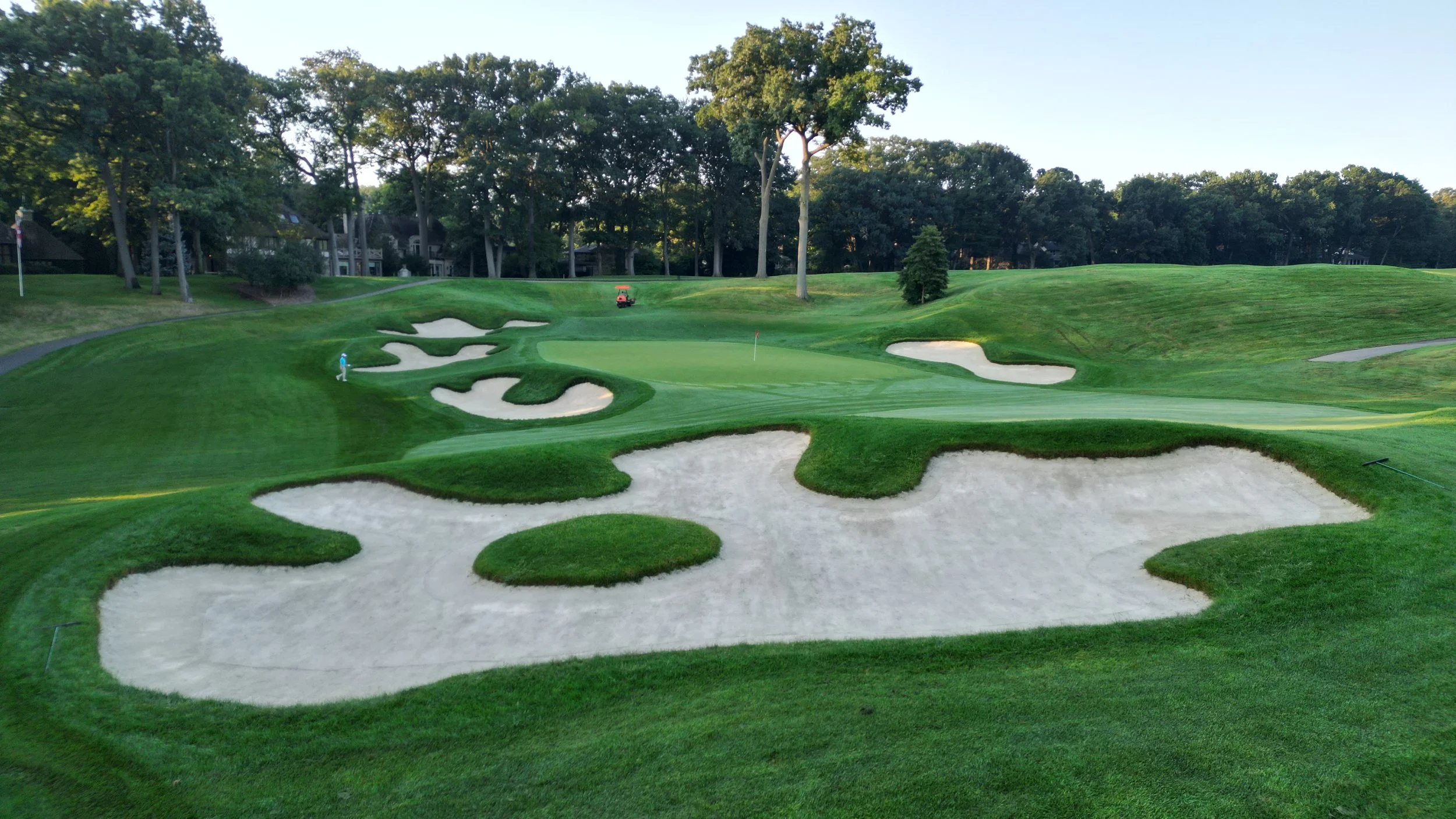
Third hole at St. George’s cleverly hides most of its surface, and the fact you can run the ball, by placing these fronting bunkers strategically.
Variety in Character and Sequence
Great courses never repeat themselves. Each hole presents distinct character — different lengths, shapes, strategic questions, and visual impressions. The sequence of these holes matters too. A stretch of three long, grinding par 4s in a row creates fatigue. A short, drivable par 4 following a demanding par 3 creates rhythm and release. For example, Cabot Links plays to a par 70 with an unusual distribution of hole lengths. Highlands Links uses the extreme variety of its terrain — oceanside, forest, river valley — to create a round that feels like three different courses stitched into one coherent journey.

The unusually rambunctious terrain at Highlands Links showcases immense variety of the holes like the brilliant par 5 15th.
How to Evaluate What You're Playing
The next time you play a course you've never seen before — or even one you've played a hundred times — try asking yourself these questions. They won't make you an architecture expert overnight, but they'll sharpen your eye and may deepen your enjoyment of the game.
Does this hole give me a choice? On the tee, look for at least two viable strategies. Is there a safe side and a rewarding side? Can you see how a different player might attack this hole differently than you? If the answer to every tee shot is "aim at the middle of the fairway and hit it straight," the hole lacks strategic depth.
Can I use the ground? Try bumping a few approach shots along the ground instead of flying everything to the pin. Does the course reward this? Are the green fronts open, or is every approach guarded by a bunker or a sharp false front that demands a purely aerial game? Courses that allow and encourage ground approaches are almost always better designed than those that don't.
Do I remember each hole? After your round, mentally walk through all 18 holes. How many can you distinctly recall? On a great course, every hole has a clear identity — a shape, a feature, a moment — that distinguishes it from the rest. If large stretches blur together, the design lacks variety.
Does the routing change direction? Pay attention to where the sun is and which way the wind blows throughout the round. On a well-routed course, you'll face the wind from multiple directions and the sun will move across your field of vision. If you play four or five holes in a row heading the same way, the routing is weak.
Would I want to play this again tomorrow? This is the ultimate test. Great courses reveal new details on every play. The more you understand the design, the more decisions you see, and the more interesting those decisions become. Courses that feel fully understood after a single round rarely have the architectural depth to sustain long-term interest.
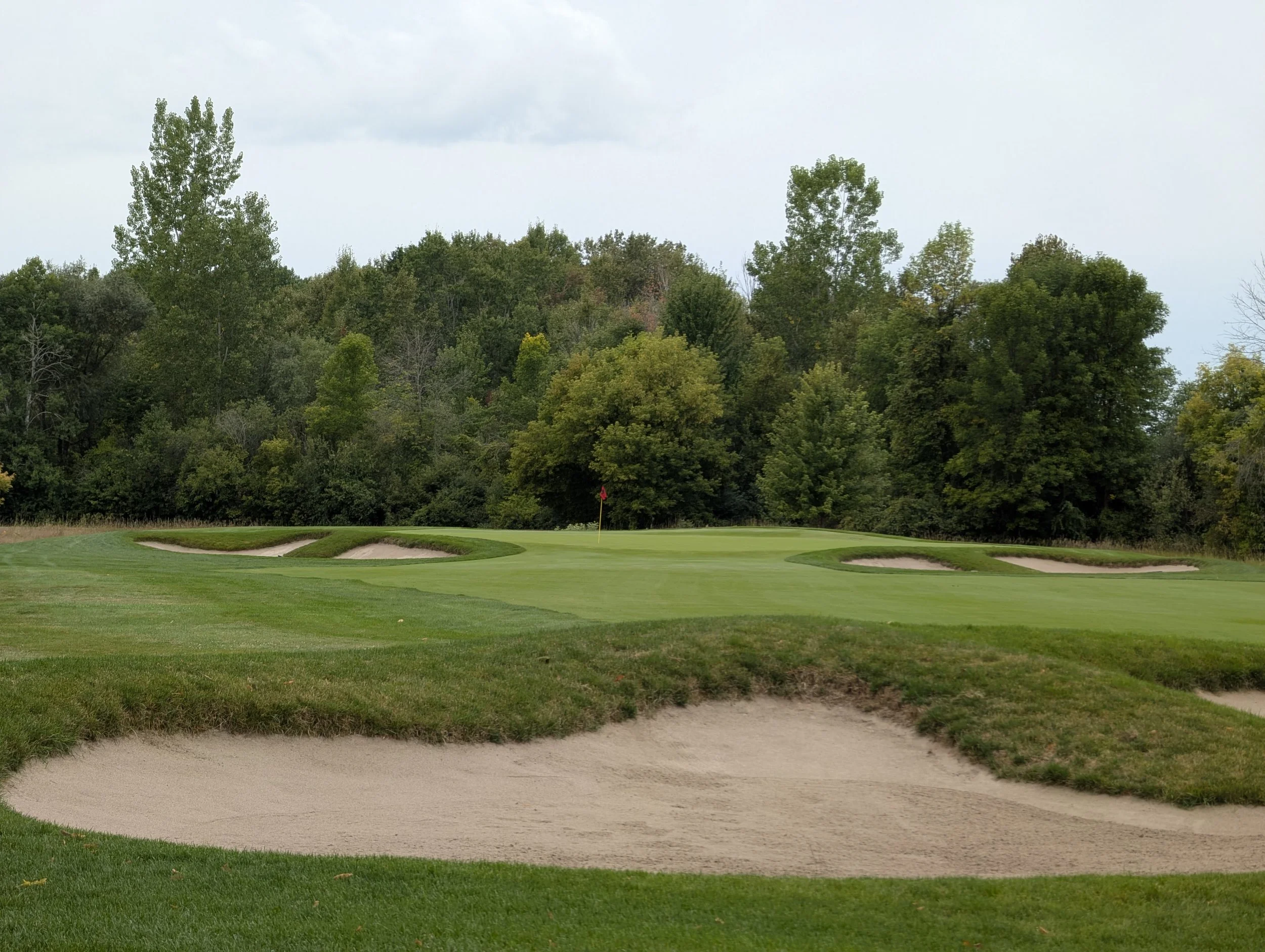
Rideau View - A nice golf club, but one that lacks the variety to elevate itself into the Top 100 in Canada. 17/18 greens designed with a small open mouth and one, or more often than not, two bunkers on either side.
Why This Matters
Thinking critically about golf courses isn't an intellectual exercise for its own sake. It has practical consequences.
As consumers of the golf product, we vote with our wallets. When golfers flock to courses purely on the basis of rankings or conditioning and ignore architecturally superior alternatives, the market rewards the wrong things. Clubs invest in cosmetic maintenance and marketing rather than thoughtful design considerations. Developers build courses that photograph well rather than courses that play well. The game gets more expensive and less interesting.
As advocates for preservation, understanding architecture helps us recognize what's worth protecting. When a club hires an architect to make updates to their layout — adding yardage, rebuilding greens and bunkers — something often becomes lost that can never be fully recovered. The more golfers who understand and appreciate original design intent, the more pressure there is on clubs to restore rather than reinvent.
And as golfers, developing an architectural eye simply makes the game more enjoyable. Once you start seeing the decisions embedded in each hole every round becomes richer. You're no longer just hitting shots. You're reading the architect's mind and responding to the questions they set.
Canada's greatest golf courses are great not because they're exclusive, or expensive, or blessed with dramatic settings. There are numerous great golf courses that have none of those, and plenty of them that have all three. They're great because they were designed with intention, built with skillful craft, and maintained with respect for what the architect put in the ground. Learning to see that is learning to see the game itself.
